Showing posts with label strange history. Show all posts

Friday, August 28, 2020

Killer Unknown: the Villisca Axe Murders

The daybook, Chicago, 14th June 1912.
 Public domain

Every town has it's haunted house, a grim-looking place where terrible things have happened or are
rumoured to have had happened. But not many can boast of a crime quite like the Villisca Axe Murders of 1912. A crime so brutal that it replaced the recent Titanic disaster on the front pages of many American newspapers. People were fascinated by true crime, even 108 years ago.


June 9th, 1912.
The Moore family returned to their home after an enjoyable, but busy, day out. The family was made up of Josiah (43 y/o), Sarah (39 y/o) and their four children, Paul (5 y/o), Boyd (7 y/o), Katherine (10 y/o) and Herman (11 y/o).
Joining them were Lena (8 y/o) and Ina Mae Stillinger (12 y/o), two of Katherine's friends, who had been invited over for a sleepover. They'd spent the day at their local church, attending a Children's Day event organised by Sarah and they didn't get home until late, around 9:45 or 10:00.
It's not known what time they all went to bed, but it's safe to assume they had some tea first and spent some time unwinding before they did. Eventually, the household would go to bed, the Moores and their brood in their own rooms upstares and the Stillinger girls in the guestroom downstairs.
None of them would ever wake up.

June 10th, 1912
The Moores neighbour, Mary, has started her day. But, as she goes about her morning routine, she can't help but notice that something is missing and that something was the Moores. See, at that point in the morning, the children should have been out and about, starting their daily chores. To Mary's growing concern, as the morning went on there was no sign of life over at the house next to hers. She assumed that the family had fallen ill and went to check on them. The curtains were still drawn and the house seemed dark. Mary first tried knocking on the door, then calling out to the people inside, but got no response. Her attempt to let herself in was met with something unusual; a locked door. It was unusual because in those days, in those sleepy, safe little towns, people would leave their doors unlocked. They had nothing to fear, or at least thought they didn't, but what would be discovered inside that house would have the whole town locking their doors and windows. Unable to get in, Mary called Ross Moore, Josiah's brother and owner of a spare door key. And, being the good person she was, while Ross let himself into the house, Mary fed the families chickens, thinking she was doing her friends a favour. She wasn't expecting him to come running out, calling to her to call the police.
Inside the house had been ominously silent, Ross may have been expecting to find something grim but nothing could prepare him for the horror contained inside that building. Wandering around the ground floor, calling for his family, he came across the guestroom and its chilling contents. And having guessed why the family was nowhere to be seen, he fled.
Photo by Jennifer Kirkland, CC BY-ND 2.0

Town Marshal Horton and his men arrive to discover a human abattoir and a rapidly growing crowd of onlookers. A search of the house reveals that somebody has taken the families axe from the woodshed and, starting with Josiah and Sarah, killed everyone. These murders were methodical and precise. Everything seems to indicate a lot of anger and most of this rage seems to have been aimed at Josiah. Mr Moore had been struck at least thirty times, with both the blade and back of the axe. The force of the blows rained down upon him were strong enough to pop his eye right out of its socket and the murderer had gone out of his way to demolish Josiah's face. Investigators even found chunks gouged out of the ceiling above the bed, where the axe had been swung back so far that it had struck it. After finishing of the adults, he went after the children and, after he was finished, he went back to the parent's room to beat Josiah's face into an unrecognisable mush. Once he had done so he went downstairs and killed Lena and Ina Mae. And this is where it starts to get weird. Or weirder. You see, killing someone with an axe, especially when using such extreme brute strength, is going to make a lot of noise. And yet no one woke up, except for possibly Lena Stillinger. She was found lying sideways across her bed and there were signs of a struggle, defensive wounds on her arms. But other than Lena, it looks like everyone just slept through the carnage. Sarah, tucked up in bed with Josiah didn't stir as her husbands head was caved in. The children didn't wake as their siblings, in the same room as them, had their short lives ended. And Ina Mae Stillinger didn't wake as her sister fought off her attacker. Stranger still, after finishing off his victims, the killer had covered their faces, mirrors and other reflective surfaces with bedsheets and items of clothing. This could indicate two things. The first possibility is that it was an act of remorse, the killer knew they'd done wrong and this was some strange way of showing respect to the victims, much like wrapping a body in a burial shroud. The second possibility is that he was covering his tracks, much like how serial killer Andrei Chikatilo would put out his victim's eyes for fear that they somehow contained his image burnt onto them. Is it possible the killer thought this act could prevent him from being caught? For some reason, the killer also removed a 4lb cut of bacon from the pantry, only to discard it in the living room along with the murder weapon, which he propped up against the wall. Was this some bizarre attempt at making the murders look like a robbery gone wrong, or had the killer intended to take it with him but forgot it or changed his mind? Police also found a bowl of bloody water, as if the killer had tried to wash himself clean, before leaving and locking the door behind him.
Doctors on the scene work out that the crime had been committed sometime between 12:00 am and 5:00am, but it doesn't seem that they looked into why no one had woken up while it was happening. 
Considering how much of a shambles the investigation was, it's possible that they did look into it but the evidence was lost. 


Crime Scene or Circus?
Photo by Jennifer Kirkland, CC BY-ND 2.0
The local law enforcement's half-hearted attempts at investigation pretty much ensured the killer would never be found and the suspect list they came up with was based on rumours and mudslinging rather than actual evidence. They didn't rush to start a manhunt, believing that it would be a waste of time and the killer would be long gone. Some even dismissed the case as just part of a string of similar murders that had been taking place at the time. Worse yet, in a time where forensic science was still developing and relied on an untampered with crime scene, the police didn't properly secure the building. All they did was warn the crowd outside not to go in and made no real attempt to stop them when they started to do so anyway. It was a small town and news travelled fast. The crowd that had been outside when the police arrived had swelled in numbers. Driven by morbid fascination, they ignored the police and proceeded to enter the house. Over 100 people treated a tragic crime scene full of gore as a sideshow, wandering around the house like it was a museum and, most likely, destroying vital evidence. The desecration didn't stop there, as one of the ghoulish visitors took a chunk of Josiah's crushed skull home with them, as a souvenir. 
All this while the families of the dead watched on in grief and horror.


The Suspects
Despite the lack of real evidence, there was no shortage of suspects, with people being blamed left, right and centre. There were seven suspects in total, most of it comes across as a bit of a witch hunt. In some cases, it looks as if the police were trying to cover up their incompetence at the crime scene by desperately scrabbling for someone to blame. But, as you'll see, there are a couple of potential suspect here.

Sam Moyer
It's said that when a murder happens, it's usually perpetrated by someone the victim knows. And the Moore's definitely knew Moyer, as he was a family member, Sarah's brother. He became a suspect when it came to light that he'd often threatened the life of his brother-in-law, but his alibi was a solid one and resulted in him being cleared of all charges at the inquest.
It's worth noting that while Sam had a history of threatening Josiah, there are no reports of those threats being extended to his sister, nieces and nephews. 

Henry Moore
Henry's surname is just an odd coincidence, since he was in no way related to the victims. I've mentioned before that there was a slwe of violent axe murders being commited at the time, which some consider the Villisca murders to be a part of. Henry was one of the suspects for those murders, incriminating himself even further when he took and axe to his own grandmother, wife and infant child.
Despite this he wasnt officially charged for the Villisca murders, remaining only a suspect and it's worth pointing out that the murder of his family was one fueled by greed. He'd taken out insurance on each of them and it appears that he was hoping to pass the murders off as one of the many commited at that time, so that he could make a claim.

Reverend George Kelly
To the people of Villisca, Reverend George was a bit of an oddball and a creep. A travelling minister, he attended the same church event that the Moores did before their deaths and left Villisca sometime around 5:30am, not long after the murders had happened. What made people even more suspicious of him is that he'd often been seen peeping through peoples windows and had been accused, multiple times, of asking young girls to pose for naked for him. Young girls around Lena Stillinger's age and up. He was also completely obsessed with the crime, bothering the families and the police with letters and attempting to sneak onto the crime scene, when it was secured, by pretending to be a policeman. He even told a P.I. that he'd been around the house the night the murders took place and may have witnessed it, but the police didn't bother to take him into custody for the murders until 1917. That's a whole five years after the murders took place. After hours of interrogation, they got a confession out of him and sent him off to court. He would go to trial two times and be acquitted on both occasions. At the first trial, the jury looked at his history of mental illness and refused to sentence him. At the second he went back on his claim that he'd committed the crime, insisting that the police had beat the confession out of him. 

Andrew Sawyer
Andrew was a railroad worker, a bit of a loner, with no link to the Moore family. And like the rest of the nation, he was fascinated by the murders that had taken place, but fascinated to the degree that his constant talking about it unnerved his co-workers enough that they complained to the crew's foreman. The foreman, a man named Dyer, took him aside to speak to him about it, hoping to solve the strange problem. He was shocked when Andrew admitted to being in Villisca the night of the murder and told him that had heard it happen, but ran away for fear of being blamed for it. As a transient, he would have made the perfect scapegoat. Dyer was so unnerved by this that he immediately reported the man to the police. Despite his bizarre claims, Andrew was able to provide the police with a pretty solid alibi, as on the night of the murders he had been arrested for vagrancy in Osceola, Iowa. This lead to him being dismissed as a suspect.

Paul Mueller 
A European immigrant, Paul Mueller was never arrested or charged for the Villisca axe murders and is a relatively new suspect in the case, having been suggested as the murderer in Bill James and Rachel McCarthy's 2017 book The Man from the Train. Evidence against him includes him being tracked in a year-long manhunt, accused of killing a family in Massachusetts in 1897.

Frank F. Jones
Out of all the people on this list, it seems that Mr Jones had an actual reason for wanting Josiah Moore dead. An Iowa State Senator living in Villisca, before he turned to politics he had owned a store there. And who worked for him? None other than Josiah. Josiah who turned out to be so good at his job that he would go on to leave Jones' employment and open a store of his very own, taking a lot of high paying customers with him in the process. On top of that, there was an unfounded rumour going round that Josiah was having an affair with Jones' daughter in law. 
Although he went uncharged for the murders, many of the locals, including the father of the Stillinger sisters and Ross Moore himself, still strongly felt that he was the guilty party. It was suggested that he'd hired someone to commit the deed, rather than risk dirtying his own hands and reputation. Josiah's family and their friends? Collateral damage. But who could he hire to do such a terrible thing? Well, that would be William Mansfield, the next suspect on our list.

William Mansfield
I chose to place Mansfield after Jones on this list, because of their possible link to each other. He was a deeply unpleasant person and one who wasn't just a prime suspect for the string of axe murders that had been going on, some even suspect him of being a potential suspect in the Axeman of New Orleans killings. He even killed his own wife, parents-in-law and infant child with an axe just two years after the Moores murders. Yet he wasn't investigated for killings in Villisca until 1916 and was quickly acquitted as he had a seemingly solid alibi. A witness would later come forward stating that he'd seen Mansfield in Shenandoah, Iowa, heading to the train station. If this is true then it blows Mansfields alibi clear out of the water, but he was never re-arrested. At the same time of his first arrest, Frank Jones was pushing for the arrest of Reverend Kelly, an investigator at the time believes this led to Mansfields release and the subsequent trial of Kelly.


A Crime Unsolved.
There are few crimes as chaotic as the Villisca Axe Murders, with the surviving family members being failed so abysmally by those who should have been supporting them and solving the crime. Even with seven suspects, no killer was ever bought to justice. I'll leave it to you to make up your mind which one of the accused committed the crime, if any and I'd love to hear your theories in the comments. Or, as always, if you'd prefer to do so, then you can tag me in a post on Twitter. Personally, I side with the theory that it was Jones and Mansfield. Being popular in the community, Josiah Moore would have been an even bigger thorn in Jones' side had he decided to jump into politics as well, not to mention the rumours about the alleged affair would have damaged Jones' families reputation to a degree. Out of everyone on that list, Jones was the only person to have a real reason to want Moore out of the way, Mansfield was the perfect tool to get the job done and Reverend Kelly was the perfect sacrificial lamb. I'm not saying Kelly was an angel. Far from it, he was a complete dumpster fire of a human being who had already had numerous complaints raised against him for his odious behaviour, but he'd never shown signs of being violent before and seems to be the only person to be interrogated to such a degree that he admitted to the crime. Kelly was a very scrawny, malnourished looking man whom I doubt would have had the strength to kill one person with an axe, let alone do that amount of damage. Mansfield could though, and proved it by committing a near-identical crime two years later when he slaughtered his own family. It would also make sense that Jones would approach someone who didn't live locally to kill the Moores.
Photo by Jennifer Kirkland, CC BY-ND 2.0

One thing has always fascinated me though; why didn't the family wake up? Again, the murders wouldn't have been quiet. If they were sleeping naturally then they would have woken up, there would have been panic and screaming, and survivors. One theory does come to mind and that is that the family had been drugged. Barbiturates were readily available in many forms in those days, buying them was as easy as buying a packet of sweets. You picked your poison and you paid for it. If the family had a late tea planned for when they got home, Sarah probably would have prepared it in advance and left it out ready to reheat, making it easy for a home intruder to slip something a bit stronger than salt and pepper into the mix. There is a theory that instead of entering the house after everyone had gone to bed, the killer was already hiding in the house when they got home, in the attic. When searching the house for clues, the police found cigarette butts up there, adding weight to this theory, but they also could have come from one of the many townfolk who trudged through the house that day. However, the possibility of someone lurking up there, waiting for the unfortunates below to go to bed, ties in very well with the family being drugged, since the suspect would have had to enter the house to do so. It also adds another level of horror to the situation. Even if the family had locked their door, they wouldn't have escaped.


A Murder House in Modern Times
These days, the Moores home remains unlived in, but not completely abandoned. It would seem that the Moores never left. Visitors to the house have reported the sound of children playing and running from room to room, doors slamming on their own and opening just as easily, plus unexplained banging and dripping noises. The temperature will drop without warning, a feeling of darkness and heaviness will invade the atmosphere, and both shadow figures and an odd mist have been seen roaming the halls. Evidence has been caught on camera too. Subsequently, the house is on most paranormal enthusiasts bucket list and has featured on many ghost hunting programs and documentaries.
The strangest thing to happen in the house to date (other than the hauntings and the murders.) would have to be the accident that occurred there in 2014. honestly, I can't think of any other way to describe it than as an accident, but a visitor staying the night for a paranormal investigation stabbed himself, in the chest. There was no warning that it was going to happen and he didn't give a reason as to why he'd done such a thing, but the police did out foul play. Because of the building bloody history and alleged hauntings, a lot of people have linked the visitors odd behaviour to that, but he would appear to be the only person who has felt the need to harm themselves in the house.
Speaking of paranormal investigations; the house had various different owners after the 1912 tragedy, until it was bought in 1994 and renovated. All modernities were stripped back and the house returned to it's early 1900's glory, to how it would have been when the murders occurred, complete with historically accurate furnishings, decore and accessories. The owners now allow people to visit the house, running daytime tours and night experiences that allow you to sleepover. And if you're unable to travel to Villisca for a tour (or are just too scared to.), you can take a virtual tour of the house instead. 

Photo by The Man-Machine, CC0 1.0


Have you visited the Villisca Axe Murder house? Have a story of your own to tell, maybe some evidence of the paranormal or just your own theories as to who committed the terrible deed? Let me know in the comments below or tag me in a Tweet! As always, I adore getting comments from you guys and hearing any fascinating stories you have to tell.

Friday, July 31, 2020

Fae on Film: The Cottingley Fairies.

The Fae are a big part of our folklore, having seemingly existed for as long as we have written records.  For creatures that may or may not exist, they are important to us, continuing to be a big part of our culture and some religions to this day. They also have a fascinating duality to them; the dark creatures of our folklore and the glittering nymphs of our fairytales. And it's those saccharine sweet Fairytale Fairies that we'll be looking at today. The darker Folks will get a blog post of their own another day.
The Victorians (or at least those who could afford to be) were a desperately romantic bunch, clinging to magic and mystery in a world that was rapidly becoming swamped by industry and science. Spiritualism was still finding its feet in the world, all that was mystical or paranormal was being sought out. So, when in 1917, photos came to light of two young girls posing with seemingly real fairies, people were delighted. These photos are iconic. Chances are you've seen them before and, even if you weren't aware of where they came from, you were most likely charmed by them. It's hard not to be. Like something from a fairytale, innocent-looking girls surrounded by crowds of delicate, dancing Fairies. Although, by modern standards (either photoshop, CGI or a man in a Bigfoot costume) they're clearly fake, in the 1900's photography was still an ever evolving art. 

By Elsie Wright (1901–1988) - Scan of photographs, PD-US


Francis Griffith (10 years old) had travelled to England from South Africa, to stay with her Aunt,
Uncle and 13-year-old cousin, Elsie Wright. The two soon became best friends, inseparable. So, how are these children responsible for one of the worlds most famous hoaxes? The same way many hoaxes start. It was a prank. With a beautiful garden to play in and only a sparkling brook separating it from the local woods, they could let their imaginations run wild. So it's somewhat unsurprising that when they were told off for continuously coming home with torn pinafores and muddy shoes, they chose to blame the whole mess on the fairies they claimed lived at the bottom of the garden. No matter how many times they were scolded, the girls insisted it was because they'd been playing with the fairies and told their parents that they could prove it, if Elsie's father would just lend them his camera. After a quick lesson on how to use it, the girls trotted off with the camera, only to return an hour later. And, when the glass plates from the camera were developed, they showed the girls interacting with what appeared to be Fairies. Elsie's father immediately called the girls out on it, correctly guessing that the Fairies were paper cut-outs, even going as far as to search their rooms and the garden for evidence when they insisted the little people in the photos were real. Unable to find anything, he confiscated the camera. Elsie's mother, while shocked, believed the photos were real. Nothing her husband could say could convince her otherwise, but she still wanted to get proof and took the photos to Bradford with her, where she attended a meeting held by the Theosophical Society, who were dedicated to investigating the paranormal. When the lectures had finished, she pulled the speaker aside and explained the whole situation to him. Taking a look at the photos, he was so convinced of their authenticity, that he took them to their annual conference and put them on display for all attending to see. One of the many people attending that conference was a Mr Edward Gardner.
Edward Gardner
Gardner was fascinated but, like Elsie's Father, also a little sceptical. He was the first person to take the photos to an independent expert to be examined, although the expert became convinced that the photos were real after finding no evidence that the glass plate had been tampered with. And it's here that the innocent prank turns into a full-on hoax, as word of the photos and Gardner's testing of them reaches the ears of Sir Conan Arthur Doyle; creator of Sherlock Holmes and enthusiastic seeker of the paranormal. As convinced as everyone else that the girls had produced evidence of the existence of Fairies, he wanted to bring the photos to an even wider audience. As a contributor to The Strand Magazine, he contacted the Wights to ask for their permission to publish the photos and an article about them. And when he gained permission from the surprised family, he contacted Gardner. Working together, Gardner and Doyle would go on to get the photos checked out by more photography experts. Only one of these was convinced the whole thing was faked, so they disregarded his opinion, choosing to go with the majority. 
1920 bought more fairy photos. Doyle was busy and asked Gardner to visit the girls, investigate their story further and secure more evidence. The trip was a success. The girls agreed to take more photos, but on the understanding that they would be allowed to do so alone. The fairies, they explained to Gardner, would only appear to children and only then when there were no adults present. This allowed them to set up some hastily made paper models and shoot a few photos. One can assume that it also gave them some time to panic in private and discuss what on earth they were going to do, because the prank had
Sir Arthur Conan Doyle
gone too far. They weren't just fooling their parents anymore, there were serious intellectuals involved and they thought the photos were real. Three photos were taken and these would be the last ones the girls ever produced. Even when Gardner visited them again in 1921 with a medium in tow, the girls told him there were no fairies present at that time. This didn't matter to Doyle, however. He proceeded to publish a second article on the subject, and even used the photos to write a book, The Coming of the Fairies, which was published in 1922. Both the article and the book were met with mixed reactions, the Cottingley Fairies fame had started to wane with that of the supernatural. Some people were still convinced, but others were sure they were faked, even calling into question the Fairies "fashionable" hairstyles as evidence of this. Even though people had lost interest, the story didn't end there, not for Elsie and Francis. For decades after they would have to put up with people wanting to speak to them about the fairies, but these people only wanted to know if the photos were fake and how they'd done it. I've got to give them credit, they were as brave as they were clever, admitting nothing. Even when James Randi got involved in the 1970s, pointing out that the Fae in the photos were identical to those published in a book from the 1900s, a book the girls were most likely to have owned, they said nothing. It wasn't until 1983 that the photos were officially debunked, with Elsie admitting they were faked. Her father had been right when he'd said they were paper cutouts and Randi was right when he'd spoken about the book. The girls had traced the books illustrations, colouring them in and mounting them on hairpins. This allowed them to stand the Fairies up without fear of them falling mid-photograph. They maintained the hoax out of pure embarrassment, Elsie reported. After fooling Gardner and Doyle, the articles and the book, it was easier to keep up the ruse than admit that it was false. And Francis? Francis swore the photos were genuine to the very end.

By Frances Griffiths (died 1986) - Scan of photograph, PD-US

I can only wonder how that felt for Elsie and Francis, to live their whole lives haunted by what started as a harmless bit of fun, to live with the knowledge that if they told the truth then it wouldn't be a few people laughing about it but hundreds of them, mocking and jeering. The dread of knowing that they'd go down in history not as the Boy Who Cried Wolf but as the Girls Who Cried Fairy. In Victorian times, a persons reputation was everything and once that reputation was damaged, they would either become a joke to their peers or be shunned completely. And, of course, they would have known that it wasn't just their reputations at risk, but Gardner and Doyle's too.
I don't know about you, but I'm fond of the Cottingley Fairy photos. The images speak of a more innocent time, something a lot of us left behind in our own childhoods. They must have had so much fun taking those first photos, before it all spiralled out of control. At the same time, there's something sad about them and I think that feeling stems from knowing the story behind them and what the girls went through for their entire lives.

What do you guys think? Sympathetic, or serves them right? Harmless prank turned hoax to save their reputations, or malicious prank stemming from a string of lies? Let me know in the comments below or tag me in a Tweet, you guys know I love to hear from you!


Thursday, June 20, 2019

Bad Dog: the Black Shuck of Suffolk.

August 1577. Suffolk, England.
A terrible storm rages over head as the parishioners of Blythburgh take shelter in the Holy Trinity Church, hiding from what they believe what must surely be Gods wrath. It sounds as if the very heavens themselves are tearing at the seams, but here in their pretty little church they are warm, dry and safe. Or so they think. A flash of lightning lights up the church interior, accompanied by a rumble of thunder best described as a roar, startling those huddled within. Shock soon turns to horror, as the roar of the thunder is replaced by the snarling of a beast and they realise that a huge black hound is among the congregation, running up and down the nave. The people panic, trying to get away or shield their loved ones as the great dog snaps at their heels. It's pandemonium. Fear fueled chaos, but it's over almost as soon as it started. The hound makes it's escape, forcing it's way out of the church and leaving claw marks burnt into the door, as well as three corpses and a lot of terrified people in it's wake. And the horror doesn't stop there. Leaving Blythburgh behind, the hound traveled to Bungay.
Twelve miles from Blythburgh, the people had taken shelter in St Mary's Church and they too thought they were safe. They weren't expecting a hellhound to burst through the doors in a flash of lightning. Once again, it terrorised the flock, biting, snapping and this time buring. No one saw it coming, nobody dared stop it and, by the time it had finished, two men were dead, others injured, the church door was destroyed and a lightning strike had caused the church steeple to collapse.
This, dear readers, is the Black Shuck. Alternatively known as Old Shuck, it is one of England's most infamous black dogs.
I've only covered this topic once before, and briefly, in a post about haunted Dunwich. It's name is said to have it's roots in the Old English word Scucca, meaning Devil or Fiend. A good way to describe a terrifying hound of indeterminate breed, being either of ghostly or demonic origin. It's described as black and, size wise, anywhere between the height of a calf to a pony. It's eyes are the size of saucers,  glowing red and firey. Some reports say that it only has one eye, giving it an even more terrifying, cyclopean appearance. Variations of this monstrous mutt has been sighted all over England and it was even the inspiration behind the Hound of the Baskervilles. Wherever you go, it seems that every county has a not so good boy haunting it's lanes and fields, although interestingly it's purpose seems change depending on the region, much like whether or not a black cat is lucky. In East Anglia the Shuck is a sign of bad luck, a sighting an omen of death for all who gaze upon it. In other counties it seems to exist just to stalk and terrifying anyone who crosses it's path, yet in some counties it's a benign presence, helping lost travelers and providing them with a calming companion on their journey.
Pew details from Holy Trinity, a lion or a gigantic hound?
Photo by myself.
The enduring mystery of the Black Shuck is that while we know what the hound is, we don't know WHAT the hound is. It's possible they could be a throw back to the vikings, to Odin and his wolves, Geri and Freki. They could just be a mixture of religion and superstition, the Hellhounds from Christian lore. Older sightings could just be wolves, whilst newer ones could be large stray dogs. The last known wolf to be killed in the UK died in 1680, hunted down in Perthshire. There were also rumours of wolf sightings in Scotland right up until 1888. Could this explain the Suffolk Shuck sightings? Yes and no. While it's possible that one attack could be put down to a rogue wolf and coincidental weather, two attacks seem very unlikely. Not even a starving wolf would attack a church full of people, plus it was August, prey would have been plentiful elsewhere. When it comes to the Black Shuck there aren't many theories trying to explain what it was, just a general acceptance that it is some sort of unearthly dog, with a bad temper. And, while I love a good ghost story and do believe in spectral animals, I have a theory that the Black Shuck that attacked that August may have been a living dog.
As with all my little theories, it's just that: a theory, an unproven one. But, I hope you'll find it an interesting one. You see in 2014, during an archaeological dig at Leiston Abbey in Suffolk, the skeleton of a gigantic hound was uncovered. In life, this dog would have weighed about 200lbs and stood at roughly 7ft on it's back legs. What's more, it is possible that it was buried around the same time as the attacks, and hastily so, judging by the fact that it was buried in a shallow grave near the Abbey's kitchens. It's believed to be the skeleton of a Great Dane, a breed that was likely to have belonged to someone relatively important. Dane's are wonderful dogs, very sweet, but also large and can be more than a little intimidating if you aren't used to them. When I was younger, a friend of my Father had three Great Danes, including one very large black one. His name was Duke, he was a sweetheart and thought he was much smaller than he was, often trying to crawl onto the laps of anyone sitting in the living room. But his bark was loud and fierce, even though it was only used to say hello. He may have been an old softy, but had I seen and heard Duke in a darkened church, in the middle of a storm? I would have been terrified. Darkness, flickering candlelight and flashing lightning could easily twist the familiar into something abominable. I believe that's what happened here. My theory is that the dog found at the Abbey belonged to someone accustomed to visiting the churches in the area, someone who would take their loyal pet with them on these trips. A big dog would certainly provide a bit of protection on the road, no matter how daft it was. When the storm struck in August 1577, the dog either got out or was separated from his owner. As dogs are prone to do, it followed the paths it would often pass down with it's master, leading it to the church. The hound gained access to first the Holy Trinity Church and then, still seeking its owner, St Mary's. Both times it was faced with screaming people, running away from it and trying to knock it away from them, probably even throwing things. Already frightened out of it's wits by the storm, these humans behaviour scared it even more, so it lashed out. In Bungay, its
Claw marks left on the door of the Holy
Trinity Church, photo by myself.
arrival coincided with the lightning strike which destroyed the steeple and melted all but one of the bells inside. Since electricity travels, it's likely that the power from the strike transferred to any other metal in the church, thus causing burns. Adding weight to this is that official records exist showing that the two men killed in Bungay that day were in the belfry when they died. But in the 1500's, they didn't understand how electricity worked, so the deaths and burn were associated with the dog. At some point after this, the frightened dog either ran home to the abbey or was caught by it's owner, but by that time the damage was done. People were scared, some were dead and one church was in ruins. If the dog were to be recognised then the abbey's reputation would suffer, so it was quickly euthanized and buried in a shallow grave were it wouldn't be too obvious. As time passed the hound became folklore and the poor great dane was forgotten.

Like I said, just a theory.

Visiting Blythburgh and Bungay.
The weather couldn't have been less like that in the story if it tried. Plenty of sun and blue skies, a slightly cool breeze that left off after a while. It was early in the morning and after a super healthy breakfast of McMuffins, we set out sat nav for our first stop, Blythburgh.
I think my friends (M and D.) and I were expecting something from a
Holy Trinity Church, photo by myself
Hammer Horror movie, but the Holy Trinity Church is a stunning 15th century building, easily accessible with a car park right next to it. A large church, it's deserving of it's nickname: the Cathedral of the Marshes. I could go on and on about the beauty of this building alone, but you're here for the folklore. Because this is the church with the infamous claw marks. At first we couldn't find them, it turned out that we were looking at the wrong door. Opposite the main entrance is a matching set of ancient wooden doors, and it is here that the Shuck left his mark. The marks are quite deep, but smooth and shiney from years of being touched by the hands of the curious. They are definitely burn marks, but claw marks? The sceptic in me says no, most likely candle burns, but I still love the folklore behind them. Before we leave we explore the church fully, delighting in it's architecture and calming atmosphere. I'd also like to point out that, as well as tours being available there, it does have a small gift shop (cash and correct change only.) and all proceeds raised from it goes towards the upkeep and restoration of this much loved building. Outside the graveyard is also a pretty one, with a path leading around the church and down some steps to the toilets.


Bungay is much bigger than Blythburgh and also has a
St Mary's Church, photo by myself.
castle (accessed through a restaurant, Jester's, which I really recommend for good food.), an observatory and a small museum that you can visit. We didn't just visit the church, but the whole town. The Shuck is everywhere here, even the town football team is named after it. On the outside, St Mary's Church is an imposing building, but inside it is warm and soothing. It's hard to imagine the Shuck wreaking havoc here too, but according to folklore that's just what it did. The hound itself appears here as a beautifully sewn tapestry on the church wall. Take a couple of quid with you, because here you can buy an illustrated booklet telling you all about the Black Shuck and the events of 1577. If ruins or memento mori are your thing then this is also the church for you, as behind it you can find the ruins of a previous church building and the graveyard is home to many well worn, but still beautiful, skull headstones.


Have you been to Bungay or Blythburgh? Do you have any stories to tell, maybe you've seen something a little Shuck-like yourself? Let me know in the comments below or tag me on Twitter! I love hearing from you guys and, unlike the Black Shuck, I don't bite!


Thursday, June 6, 2019

The Mystery of the Rendlesham Forest Incident.


Twas the night after Christmas, and all through Rendlesham Forest, not a creature was stirring, except for some mysterious lights and a lot confused American Airmen.
The 26th of December, 1980. It's the early hours of the morning, the night is still and cold. Personnel at the American Air Force operated bases of RAF Woodbridge and RAF Bentwaters (in Suffolk, England.) are expecting a calm, if not a little boring, night shift. They aren't expecting to see unidentified lights descending upon the nearby Rendlesham Forest. Despite the Cold War still being frosty enough to ice skate on, it was decided that it must be a downed aircraft, albeit one that hadn't called for help and was on an unannounced flight plan. The police were called and immediate aid was sent out, in the form of a three unarmed men, Burroughs, Penniston and Cabansaq. They didn't find a downed plane or helicopter. What they found was straight out of an episode of the X-Files. 
They found what can only be described as a UFO: a metallic cone shaped object, with glowing coloured lights, surrounded by a sickly yellow mist.
Penniston's sketch of the craft.
The object just sat there on three tripod like legs. It had settled down in a small clearing in the forest, seemingly unbothered by the curious humans surrounding it. It sounds like a bad 1950's B movie. I think most people would have just run, but these were soldiers and they had nerves of steel, they chose to hold their ground. Braving the fear of the unknown, these witnesses were able to get quite close to the object. Penniston even edged close enough to touch it, pulling out a notebook to draw the craft and describing the air as being full of electricity in a later interview. It was estimated to be about 10ft long and about 8ft high, with strange symbols on it's hull, not dissimilar to hieroglyphs. A short while later the unknown craft retracted it's legs and shot off into the sky. Although the men attempted to follow it, there was no earthly way they could have caught it. While this was occuring, the local police had arrived at the base. In their opinion the only lights they could see were from a lighthouse at the coast, a few miles away at Orford Ness. However the Orford Ness lighthouse is unlikely to show up on radar, which is exactly what the unknown craft that was seen that night did, when it was reported by a nearby military radar station. Sightings occurred again the following night, when a young Airman by the name of Lori Boeon spotted the craft whist on night watch. She wasn't alone in seeing it, as there were five fellow airmen with her that night. The strange lights were passed off as nothing more than fireworks.
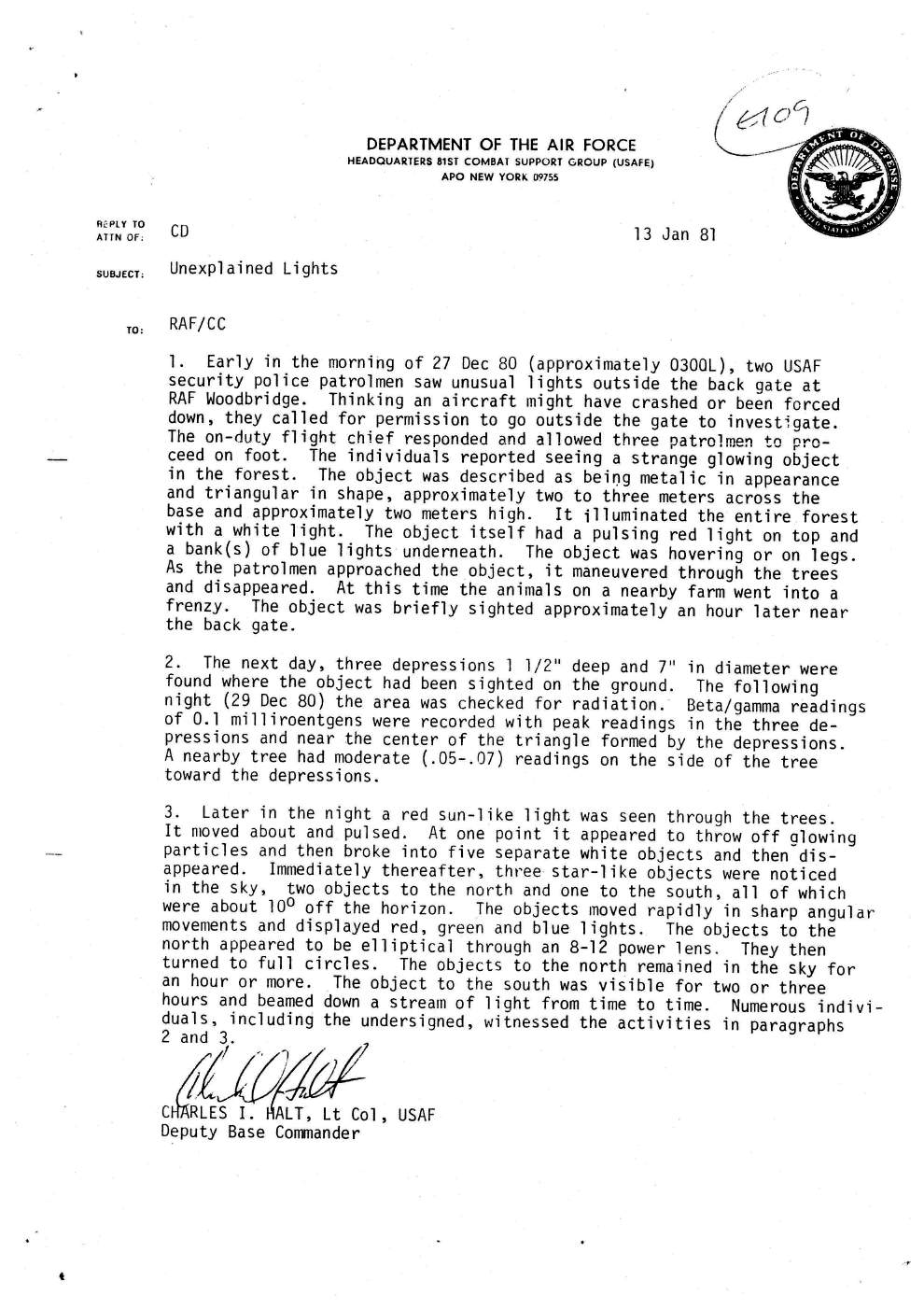
Events seemed to come to the head the following evening. Whilst a party was happening at the base the UFO was spotted again and a team lead by Lt. Colonel Charles Halt headed back to the clearing where the the first sighting had taken place. Lt. Colonel Halt was second in command at the base, showing just how seriously this odd event was being taken. Although his initial intention may have been to debunk the incident from the previous two nights, he soon found that to be an impossible task. Searching the clearing they found clear evidence of the first nights events. Trees surrounding the clearing had been visibly singed and had broken branches from about 20ft up, in the center of the clearing were three visible indentations from the objects feet*, which measured out a perfect triangle and match Pennington's sketches. They had bought scientific equipment with them, a test with a radiation survey meter revealed that the levels of radiation in the clearing were much higher than the normal background levels of radiation found outside of the clearing. Not enough to be dangerous, but still abnormal. And if that didn't alarm Halt and his team, what happened next most certainly did. They saw IT for themselves.
UFO statue, based on Penniston's sketches. Photo by myself.
This time the craft flowed through the trees, dripping what appeared to be some kind of molten metal, traces of which were never found. Halt and his team chased after the UFO as it zipped along, causing no damage to the trees as it passed through them. It hovered through the air, firing beams of light at the air base and, at one point, it's fascinated pursuers. As Halt and his men followed it into a field outside the forest, the UFO seemed to explode into five different points of light before vanishing. Both bases reported having beams of light shone into them from above that night and, like the soldiers who first sighted it, Halt and his group had radio issues for the entire time the UFO was flying around.
During all of the incidents livestock in the area became franticly distressed and both Burrough's and Halt's groups heard what they described as a woman screaming, although it is possible that could have been a fox as they do make very similar sounds. It is also worth mentioning that the Police officers theory of the lights being from the nearest light house was debunked, since the lights of the mysterious craft and those of the lighthouse were both visible at the same time and a good space apart. What adds further credibility to the incident is that it was witnessed by Airbase personnel of all levels of command, from lowest to highest. These aren't just kids messing around, someone after a quick buck, someone stoned out of their mind or a drunk on their way home from the pub. These are sensible, down to earth people. In their line of work they have to be. Even Lt. Col. Halt was so convinced that something odd was going on that he personally got involved in the investigation. He recorded his experiences on a hand held tape recorder, which you can listen to here, and wrote an official memo on the subject to the MOD, which you can read here, a couple of weeks after the event. Someone prone to imagining little green men doesn't get that high up the chain of command and to this day he swears what he saw was a UFO.
I imagine that after reading all of that that you are asking the same question that everyone asks, the question that I've asked myself. What the hell was it? Not an easy subject to approach when there's so many conspiracy theories around the event, but at the same time so much evidence. To this day UFOlogists swear that it's the most compelling evidence of life on other planets visiting us, it's what has lead to the incident being referred to as the British Roswell. The most popular theory that I've read is that the base was either being used to secretly hold nuclear weapons or experimental jets, and that the UFO was attracted by that since it seemed more interested in the base than the humans around it. Adding fuel to these theories is that some evidence from the investigation was allegedly removed from RAF Bentwaters and was transferred to another American Airbase in Germany. This has lead some to believe that even though information on the incident was released to the public, something important is still being covered up. Further proof for these theories also comes from reports that Airmen involved in the incident have been bullied into changing their stories with threats of bodily harm or worse. Seeing that these claims come from the airmen themselves, I'd say these threats failed.
Rendlesham Forest. Photo by Myself.
More recently there have been reports that the whole thing was a prank, one played by the SAS on the terrified American airmen using a weather balloon, but even that doesn't sit right in my mind. Funny, but otherwise difficult and expensive to pull off, as well as being a PR nightmare if it turned out to be true. And, seriously, how does a weather balloon zip through trees? How does one drip molten substances, effect background radiation levels and just vanish into thin air. The simple answer is that it doesn't. I would love to tell you it was an alien space craft. I would love to be able to sit here at my computer, doing my very best Giorgio Tsoukalos impression, ALIENS! But I can't. Because I don't believe it was aliens. I'm not a big believer in them as we see them depicted in the media, little grey fellas with big, dark eyes. I do believe there's something out there, I believe we're aren't alone in this huge, crazy, magical universe. And I do believe those airmen saw something. But I don't believe this was the work of little green men from mars. What I do believe is that there is something going on there. You don't remove evidence if there's nothing going on, you don't try to silence people if there is nothing to hide. The announcement that it was a prank played by the SAS, which itself came from an anonymous source, comes across as a lame excuse. My personal opinion is that it was some sort of experimental equipment designed for observation, maybe some sort of early drone prototype, and that whoever built it was using the two bases for a test run. The sighting where the thing exploded and disappeared could have been down to a design fault or built in explosive charges. This is just my theory, it's most likely as far from the truth as any other theory out there. But when it comes down to it, theories are all we have. We will never know what the UFO was, where it came from or what it wanted.

The Rendlesham Forest UFO trail
The UFO Trail is very well marked. Photo by Myself.
Shortly before writing this blog I was lucky enough to visit the forest with my two friends, M and D. Although aware of the forest and its story, D didn't realise we were that close to it and I somehow had it in my head that it was further north. So when we stumbled upon Rendlesham by accident, it was a delightful surprise. The forest itself is dense and lush, a place of rich greens and deep shadows. With well marked trails its nearly impossible to get lost, but very easy to lose all sense of time. Not ideal if, like me, you messed up with the parking meter and only have two hours to explore**. We would have liked to have had longer time there, but we had a great time. The only UFO we found was the statue placed in a clearing, deep in the forest. We saw no odd lights and the trees are so thick, so close together that I don't see how mysterious lights drifting through them could have been mistaken for those of a light house. You'd be lucky to see lights from the coast at all. There were a few areas of the forest that seemed unnaturally quiet, which I found odd since it's breading season and birds are quite vocal when it comes to announcing their territory. However the rest of the forest was teeming with life. There's a well laid out and clearly marked UFO Trail that you can follow, compleat with information boards about what happened that night. Unlike Roswell you won't get arrested for taking photos. It even leads you past one of the bases, presumably RAF Bentwaters, which was handed back to the MoD in 1993 and is now no longer used. An interesting place, but not one accessible to the public. If you're interested in this story at all, or even just like a nice countryside walk, I would recommend a visit. It's a fascinating place.


What are your theories on the Rendlesham Forest incident? Have you an odd story of your own from the area? If so, you can tag me on Twitter using my Twitter handle or just drop a comment here on my blog. Don't be shy, I'd love to hear from you!


*The local police were called in to look at these indentations too, but claimed they were the footprints of some woodland creature. There are no creatures in Rendlesham forest that make footprints that shape or size, or are capable of burning trees.
**Oops.